Roles and Responsibilities in Content Governance: Who Decides What Gets Published?
Struggling to manage content approvals? Learn how content governance defines roles, speeds up workflows, and prevents mistakes. A simple guide to organizing your content process and deciding who does what, without confusion.

Every company that publishes content, whether it's blog posts, social media posts, emails to customers, or website pages, sooner or later runs into the same problem. Something gets published that shouldn’t have. Or no one knows who approved it. Or everyone thinks someone else checked it.
Then everyone starts asking who approved it, and of course, there is no clear answer.
This doesn’t happen by accident. It’s a sign that the company doesn’t have a clear system for managing content. And the bigger the company, the bigger the consequences: incorrect information, legal issues, and damage to reputation.
In this blog, we’ll explain how to define who does what, who makes decisions, and how to organize that in your company.
Key Takeaways
- Content governance defines who does what - clear roles and responsibilities prevent confusion, mistakes, and approval gaps.
- Strategy and governance solve different problems - strategy defines what to create, while governance defines how and who manages it.
- Unclear ownership leads to delays and risks - without defined roles, content can be inaccurate, inconsistent, or unpublished.
- Hybrid governance models balance speed and control - teams can move fast while maintaining oversight for sensitive content.
- A simple system with clear rules scales best - defined roles, deadlines, and documented processes keep content operations efficient.
What is “content governance” and why do you need it?
Content governance is simply a set of rules and agreements about who creates content, who reviews it, who approves it, and who publishes it.
Many people confuse content strategy and content governance.
- Strategy answers what and why - what content you create and what it’s for.
- Governance answers how and who - what the process is and who is responsible for each part.
In small teams (2-3 people), governance may not be necessary because it’s easy to communicate and agree on things quickly. However, in larger teams (10+ people), governance becomes essential.
A content governance framework covers everything: tone of voice, legal compliance, accuracy of information, and brand consistency.
Who is involved? Key roles in content management
This is the most important part. When roles are not clearly defined, everyone assumes someone else is responsible, and in the end, no one is.
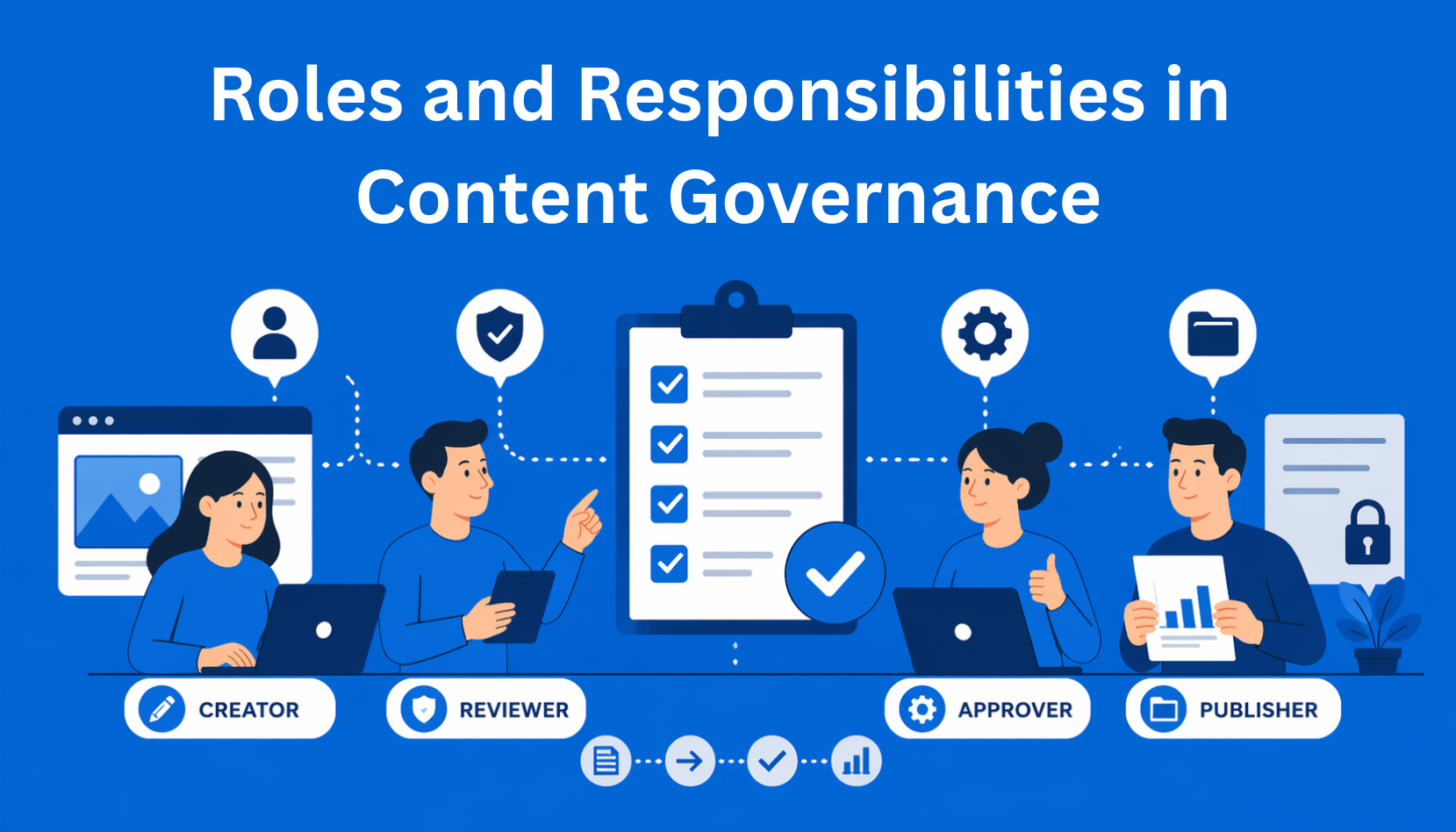
Here’s who’s who in a typical content approval process:
Author (content creator) is the person who writes the content. This can be someone from marketing, a freelancer, or someone from another team. Their job is to write the content, but they do not decide on their own whether it will be published.
Editor makes sure the content is good. They check if it is clear, well-written, and aligned with how the company communicates. If there are mistakes in style or tone, the editor fixes them.
Content owner is responsible for a specific topic. For example, if the content is about data security, this is usually someone from the IT team. Their job is to make sure the information is accurate.
Subject Matter Expert (SME) steps in when additional verification is needed. Since the author doesn’t know everything, this person checks if the information is correct.
Legal and compliance team review content related to laws, regulations, guarantees, or anything that could create legal risk. Their approval is required for certain types of content.
Brand and marketing manager ensures that everything published sounds like your company. If one piece of content sounds formal and another sounds casual, that’s a problem.
Publisher is the person who publishes the content. They upload it to the website, send emails, or post on social media. This is the final step before the content becomes public.
Who makes the final decision? Content approval models
Now that you know the roles, let’s see how this works in practice. There are three main content governance models.
- Centralized model means one person or one team decides what gets published. The advantage is consistency and control. The downside is that everything moves slower, and it can easily become a bottleneck because everyone depends on one person or team.
- Decentralized model means different teams publish content independently, without central approval. The advantage is speed and flexibility.The downside is that each team may do things differently, and the company can start to sound like multiple different brands.
- Hybrid model is a combination of both. Teams can publish everyday content on their own, but they must follow shared rules. For sensitive content (legal, financial, crisis-related), there is a separate approval process. This model is most commonly used by mid-sized and large companies.
A useful tool many companies use is the RACI matrix. RACI stands for: Responsible (who does the work), Accountable (who is responsible for the outcome), Consulted (who provides input), and Informed (who needs to be kept updated). When you map each step of your content workflow using this matrix, it becomes easy to spot gaps, where roles are missing or overlapping.
Where things usually go wrong
Even with a system in place, problems can still happen. Here are the most common ones.
“Death by committee” - too many people are involved in decision-making, so content keeps going back and forth for revisions and nothing moves forward. Everyone gives feedback, but no one makes the final call.
Solution: assign one person to make the final decision, and let others provide input only.
Legal blocks without explanation - the compliance team says “no” without explaining why. This frustrates everyone and slows things down.
Solution: agree on a rule that legal doesn’t just say “no,” but also suggests how it can be approved.
No clear owner after publishing - content gets published, but after some time it needs to be updated or removed. If it’s not clear who is responsible, no one takes action and the content becomes outdated.
Solution: every piece of content must have an owner and a review date.
Content that no one owns - some content doesn’t clearly belong to any team, so no one takes responsibility for it. This is usually website pages, old blog posts, or content created by teams that no longer exist.
Solution: run regular audits to find this content and assign it to someone.
Tools that help: modern content management platforms, such as EasyContent, where you can create custom workflows, define team roles, communicate in real time within the platform, create templates for different types of content, track content versions, and more. Instead of sending emails like “can someone review this?”, the system automatically moves content through approval steps and notifies the right people at the right time.
How to build a system that actually works
You don’t need a perfect system right away. You need a system that works better than what you have now. Here are five steps.
Step 1: List everything you publish. Everything you publish should be on the list, blog posts, emails, Instagram posts, website pages, everything. If you don’t have a clear overview, you can’t manage it.
Step 2: Look at who is actually doing the work. Not who should be doing it, but who is really doing it. You’ll often see that one person is making most decisions, or that some channels have no owner. These are the first things you need to fix.
Step 3: Set deadlines for each step. If there are no deadlines, everyone waits on everyone else and nothing moves forward. Make it clear who sends what to whom and how much time they have, for example, the author sends to the editor, the editor has 48 hours, then sends it to legal who has 72 hours. When deadlines are clear, everything moves faster.
Step 4: Create a content policy document and share it with everyone. This document should include: tone of voice, restricted or sensitive topics, approval process, and contacts for each step. It doesn’t have to be long, it just needs to exist and be easy to find.
Step 5: Review the system once a year. Teams change, channels change, companies grow. A governance system that worked two years ago may not fit anymore. Once a year, review it with your team and adjust it if needed.
Conclusion
The clearer the rules are, the more freedom people have. When everyone knows what they need to do and by when, work moves faster, there are fewer mistakes, and there’s no endless back-and-forth about who needs to approve what.
Content governance is not a luxury for large companies. It is the foundation for any team that takes content seriously.