Scaling Content Production: How to 3x Output Without Sacrificing Quality
Learn how to scale content production, create more articles, and 3x your content output without losing quality. This guide explains simple workflows, templates, repurposing, AI, and review steps that help teams publish more content with less stress.

Today, everyone who has a business or a personal brand needs to create a lot of content. Blogs, social media, YouTube, newsletters - everything requires new texts and videos. But the problem starts when you try to create as much content as possible at once, and then the quality drops or everyone starts burning out from the work.
In this blog, I will show you how to scale content production and achieve three times more output while keeping the content good. It is not about working more hours, but about changing the way you work.
Key Takeaways
- Scaling content production requires a system, not more effort - clear structure and processes allow you to increase output without burnout.
- Content pillars create focus and consistency - defining 3-5 main topics makes it easier to generate ideas and keep content aligned.
- Templates and batch work significantly speed up production - structured formats and grouped tasks reduce time and improve efficiency.
- Repurposing multiplies content output - one high-quality piece can be transformed into multiple formats across different channels.
- Quality is maintained through clear roles and review processes - teamwork, guidelines, and simple checks ensure consistency as output grows.
Why Most People Fail to Scale
Most teams and individuals fail at this because everything often depends on one person who does everything - from the idea to publishing. When that person slows down, everything stops. Another problem is perfectionism, where every text is written for hours as if it were a masterpiece.
Another common mistake is creating every new piece of content from scratch. This takes a lot of time and quickly makes people tired. It is much easier to use old blogs, posts, or ideas and turn them into new content. That way, the work is faster, the quality stays better, and the team has less pressure.
The Basics of Scaling - Build a Strong Foundation
If you want to create more content, you first need to know what you want to achieve. The point is not just to publish as many articles as possible. The point is to create content that has a goal. For example, content should bring more visitors to your website, help people sign up for your newsletter, or move them closer to buying.
That is why it is important to define the main topics you will write about the most. It is best to have 3 to 5 of these topics. For example, if you write about marketing, your main topics can be SEO, social media, email marketing, and content strategy.
When you know what your main topics are, it is much easier to come up with new articles. You do not have to start from zero every time and think: “What should I write about now?” Instead, you just look at your main topics and pull smaller ideas for new articles from each one.
For example, if one of your main topics is SEO, you can create articles about keywords, blog optimization, internal links, or SEO mistakes. This gives your content more order, everything is connected, and you are not writing randomly about different things.
After that, you need to define basic rules for content quality. This means you know in advance what every article needs to have. For example, whether the article needs a certain number of words, examples, images, internal links, a clear introduction, and a conclusion.
When there are clear rules, it is easier for everyone to work. The writer knows what they need to write, the editor knows what they need to check, and the quality stays the same even when you create more content.
Strategy 1: Use Writing Templates
Instead of creating the structure from scratch every time, make ready-made templates for different types of articles. One can be for how-to guides, another for list posts, and a third for case studies.
Templates speed up your work because you only need to fill in the sections. They also protect the brand style, so even if more people are writing, the articles still sound consistent. This is one of the easiest things that helps you with scaling content production.
Strategy 2: Batch Production - Work in Groups
Instead of working on one article from start to finish, work on similar tasks together.
- One day, do research for 8-10 topics
- The next day, write the first drafts of all the articles
- On the third day, edit everything
Your brain stays in the same mode, and everything moves much faster. Many people who switch to this way of working can easily double or triple the amount of content they create.
Strategy 3: Repurposing - One Piece of Content, Multiple Formats
This is maybe the strongest tactic for 3x output without sacrificing quality.
You write one good, longer blog post and then turn it into:
- 5-6 shorter posts for LinkedIn and X
- Quotes for social media
- A script for YouTube Shorts or TikTok
- Sections for a newsletter
- An infographic
That way, from one big article, you get 15-20 pieces of content without doing everything from scratch.
Strategy 4: Team and Clear Roles
You do not need to hire a big team right away. It is much more important that each person knows their task. When everyone knows what they need to do, the work moves faster and there is less confusion.
For example:
- One person can come up with topics and do research.
- Another person can write the first drafts of the articles.
- The editor can check the text, improve it, and make it clearer.
- Someone else can check SEO, add links, or prepare images.
If you do not have all these people on your team, you do not need to hire them right away. For some parts of the work, you can use freelancers. For example, you can hire someone only for writing, design, or SEO checks.
The most important thing is to have simple work instructions. They should explain what style you use, how the article should look, what needs to be checked before publishing, and who is responsible for what. This helps new people fit in more easily, and the quality stays the same even when more people are working on content.
Strategy 5: AI as an Assistant (Not a Replacement)
AI tools can help a lot when you create content. They can give you ideas, create the first version of a text, suggest titles, or help you build the structure faster. This saves you time, especially when you do not know where to start.
But AI should not do everything on its own. A human still needs to review the text. You or the editor need to add your own experience, check whether the information is correct, and remove parts that sound too generic.
That way, you get content that is created faster, but still sounds normal and useful to the people who read it.
Strategy 6: Processes and Tools
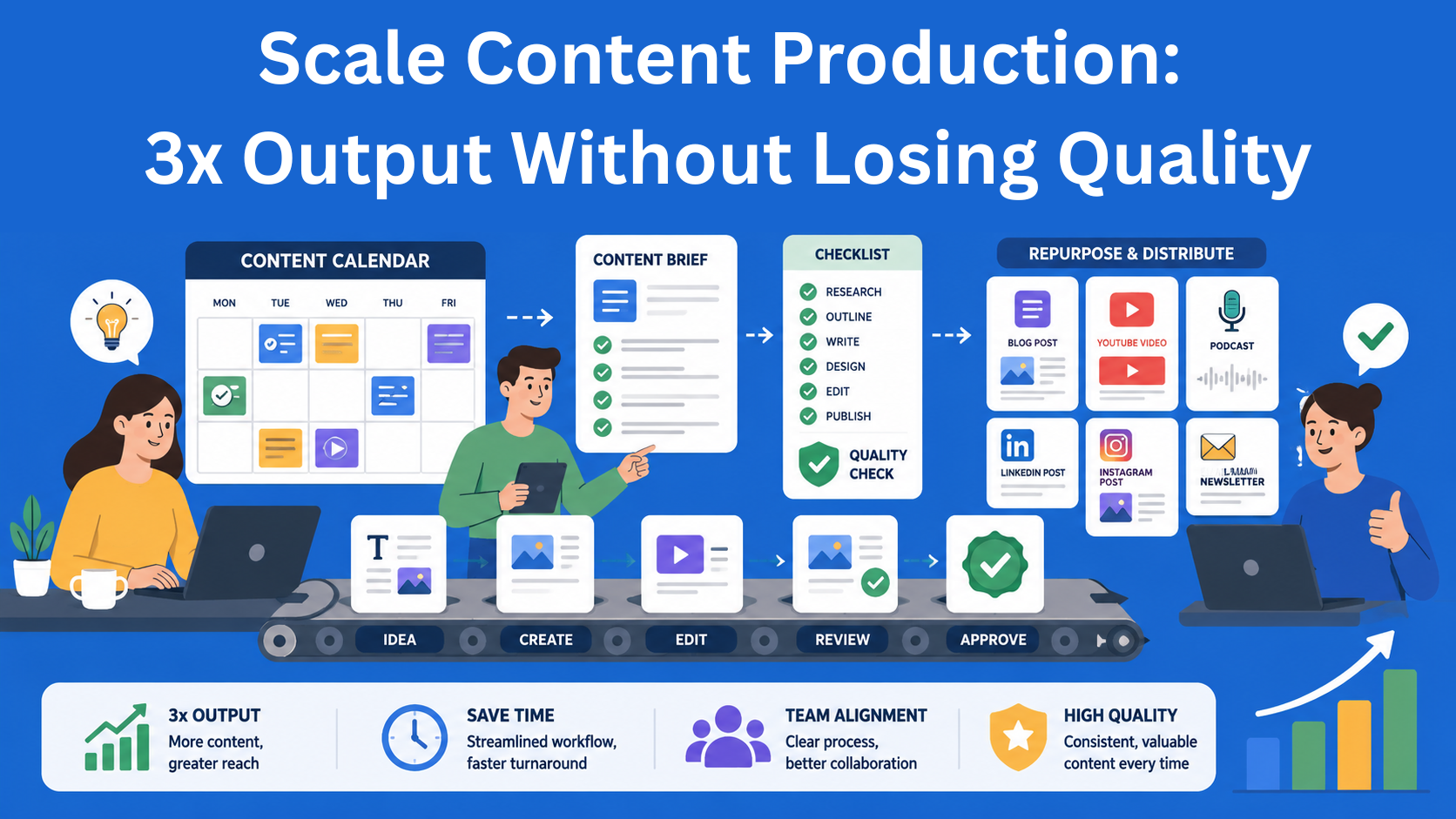
To keep everything running smoothly, use tools like EasyContent, where you can create your own workflow and assign roles to team members so you can be sure that everyone is doing exactly what they are responsible for. Also, you can create a template for any type of content, as well as a brief where you can write down all the important information related to the content. A content calendar is another option that allows you to track what was published and when.
And these are only some of the many options that EasyContent offers.
How to Keep Quality High While You Grow
If you create more content, the quality still needs to stay good. It is not enough to just publish many articles. It is important that those articles are clear, useful, and well written.
That is why you need to have a simple review system. For example, the writer should first read the article themselves and fix basic mistakes. After that, the editor should check whether the text is clear, whether it has a good flow, and whether it fits the audience. In the end, one more quick check can be done before publishing, just to catch small mistakes.
This reduces the chance of publishing a text that is unclear, shallow, or full of errors. When you have this kind of process, you can create more content without letting the quality drop.
Also, do not only track how many articles you published. That is not enough. Look at how people react to that content. For example, whether they read the article until the end, whether they click on links, whether they sign up for the newsletter, or whether they send inquiries. (You can see this through tools such as Google Analytics, Google Search Console, Hotjar, Microsoft Clarity, Mailchimp, ConvertKit, or other email marketing tools.)
- Google Analytics can show you how many people visit the article and how long they stay on the page.
- Google Search Console can show you how many people come from Google search.
- Hotjar and Microsoft Clarity can show you how people behave on the page, where they click, and how far they scroll.
- Email tools can show you how many people signed up for the newsletter or clicked a link from an email.
If you see that people are reacting well, it means you are on the right track. If they are not reacting, then you need to improve your topics, writing style, or the way you explain things.
Conclusion
- Choose 3-4 main topics (content pillars)
- Create 2-3 simple templates
- Try batch work - set aside 3-4 hours only for research
- Take one old article and turn it into multiple formats
- Set up a simple content calendar
If you do this regularly, you can already see a difference after one month. You will have a better plan, less stress, and a clearer way of working. You will not have to constantly work more hours, but you will work smarter and in a more organized way.
Scaling content production is not complicated. It simply means creating a simple system for making more content. When you know which topics you cover, who does what, how the text is reviewed, and how old content is reused, everything becomes easier.
Once you set up that kind of system, you will spend less energy and be able to create more good content. The most important thing is to go step by step and not try to change everything at once.
EasyContent onboards a new contributor without a training session
- Field guidelines and templates tell a new writer what's expected before they start
- Briefs can be claimed by a contributor the moment they're ready to start
- Mentions route a comment straight to the person who needs to see it
- Teams group contributors by client or project for quick reference