Not All Content Is Marketing: The Invisible Content That Runs Your Business
Not all content is marketing. Internal and operational content - FAQs, onboarding docs, internal guidelines, and enablement materials, quietly runs your business. This post explains why neglecting it creates friction and costs growing companies more than they realize.

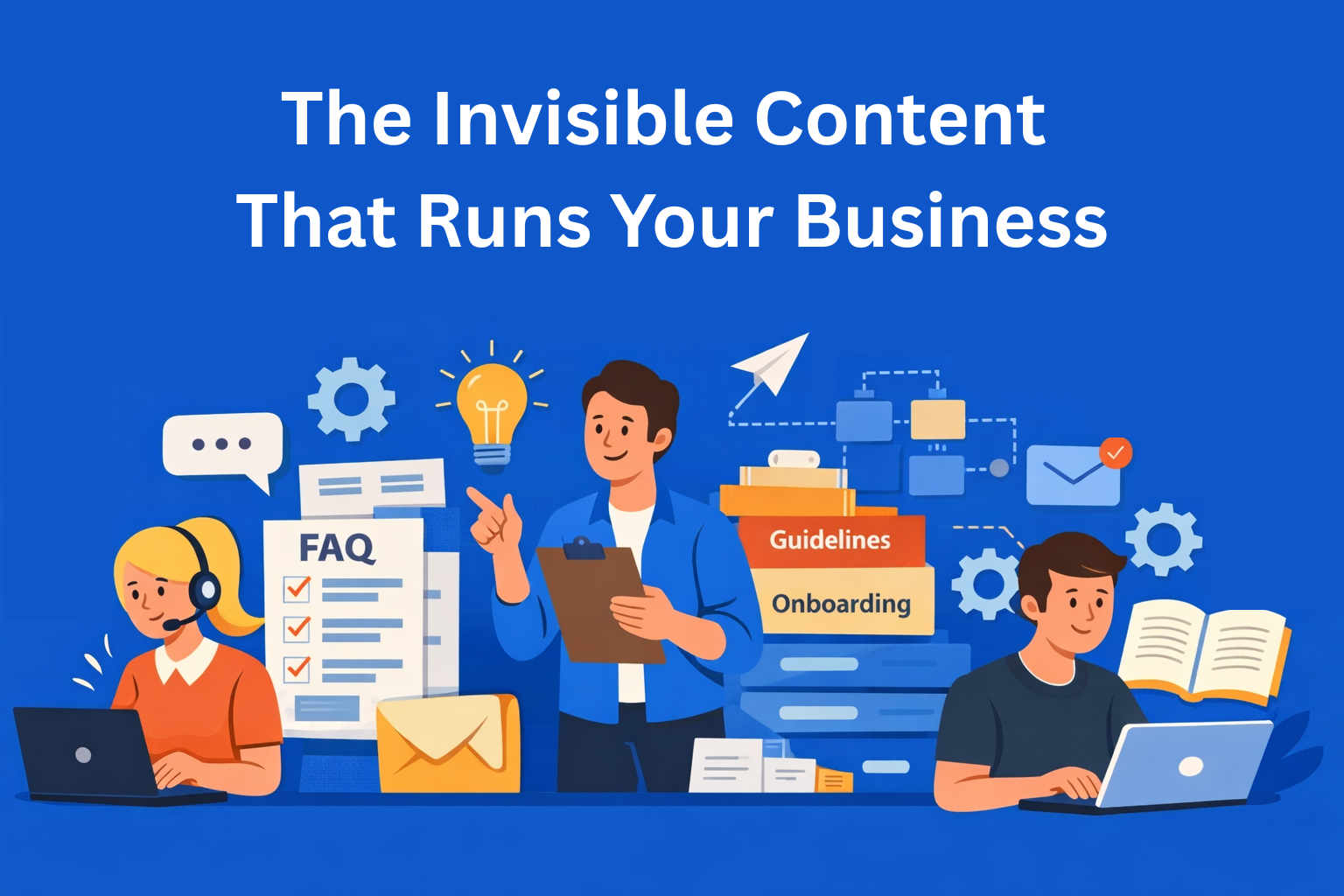
When people talk about content, they almost always mean blogs, campaigns, ads, social media, and everything that goes "outward." This is the kind of content that is visible, measurable, and promoted. However, in most companies there is a huge layer of content that is rarely mentionedyet without it, the business would not be able to function.
This includes FAQ sections, help center articles, onboarding documentation, internal guidelines, processes, enablement materials, instructions, update emails, internal presentations, and various operational documents. This internal and operational content influences customer experience, team efficiency, and decision-making every single day, even when we are not aware of it.
In this blog, we explain why not all content is marketing, why internal content is just as important, how neglecting it creates problems in everyday work, and why treating this type of content as "secondary" is one of the most expensive mistakes growing companies make.
Key Takeaways
- Not all content is marketing - internal and operational content keeps teams aligned, users supported, and work moving every day.
- Invisible content runs daily operations - FAQs, onboarding docs, guidelines, and internal updates directly impact efficiency and decision-making.
- Neglected internal content creates hidden friction - repeated questions, slow onboarding, confusion, and delayed decisions quietly drain time and energy.
- The biggest issues are ownership and maintenance - documentation without clear owners quickly becomes outdated and unreliable.
- Operational content is business infrastructure - when treated as a living system, it reduces friction, supports growth, and holds everything together.
When we say "content," what do we actually mean?
In most teams, the word "content" is immediately associated with marketing. It is something that is expected to bring traffic, leads, or visibility, which is why it is measured through clicks, views, and conversions.
However, content is much more than that. Content is any information that helps people understand what they need to do and how to do it. When viewed this way, it becomes clear that a large portion of content has nothing to do with marketing at all.
Internal and operational content is not meant for promotion. It helps the business function smoothly. It gives employees clear guidance, helps users use the product more easily, and keeps teams aligned. Even though it does not directly bring traffic, it has a major impact on how efficient a company is.
What counts as internal and operational content
When people talk about "invisible" content, they often think only of documentation. In reality, this layer is much broader.
It includes:
- FAQ pages that reduce the number of repeated questions,
- help center articles that allow users to solve problems on their own,
- onboarding documentation that speeds up the first steps for new users or employees,
- internal guidelines, processes, and SOP documents,
- as well as enablement materials for sales, support, and customer success teams.
Even internal update emails, release notes, or short internal explanations are part of operational content. All of this affects how quickly people find their way, how many mistakes they make, and how much energy they spend repeating the same things.
It is important to understand that this is not "secondary documentation." This is content that runs the business every day.
How internal content affects everyday work
Good internal content is rarely noticed. It simply works. People know where to find information, decisions are made faster, and the same questions are not asked over and over again.
When operational content is clear and up to date, teams do not waste time searching for answers. New employees get up to speed faster. Users receive consistent information, no matter who they are talking to. All of this directly improves the customer experience, even if the customer never sees most of that content.
In other words, internal content is a quiet optimizer of business operations. It does not attract attention, but it constantly reduces friction.
What happens when this content is neglected
Problems with internal content do not appear overnight. They build up quietly.
At first, small issues start to appear. Different teams have different information. The same questions keep coming up. New people repeatedly ask the same things. Documents slowly become outdated, and no one knows who is responsible for updating them.
Over time, teams seem constantly busy, but work does not move faster. People spend more time explaining things than actually doing the work. Decisions are delayed because information is unclear or scattered.
The biggest problem is that this is rarely connected to content. Instead, people blame communication, tools, or individuals, even though the real cause is often poorly organized operational content.
Why companies treat internal content as secondary
One of the main reasons is the focus on visible results. Marketing content has clear numbers and shows impact quickly. Internal content is invisible and difficult to measure.
Another reason is the lack of ownership. Often, no one truly "owns" internal content. Documents are created along the way, without a clear system, and remain that way until they turn into a problem.
There is also a common false assumption that documentation is something you create once. In reality, operational content needs to evolve together with the company. When it is not maintained, it quickly loses its value.
Because of this, internal content is often pushed into the backgrounduntil the problems become too big to ignore.
Operational content as infrastructure
One of the most important mindset shifts is to see internal content as infrastructure, not as a side task.
Just as a company cannot function without tools, systems, and processes, it cannot function without clear and reliable content that connects those systems. Operational content is the glue between people, tools, and decisions.
The difference between chaotic documentation and strong internal content is not in quantity, but in intent. When content is planned, maintained, and used as a system, it becomes support instead of a burden.
How to start organizing internal content
The good news is that you do not need to change everything at once. The first step is simply becoming aware of how much internal content already exists.
Next, it is important to identify where the biggest friction occurs. Which questions keep coming up? Where do misunderstandings happen? Which documents are outdated or contradictory?
The next step is clear ownership. Every important piece of operational content should have a person or a team responsible for maintaining it. A tool like EasyContent can help here, by allowing you to assign roles and responsibilities to each team member, so you always know who owns what.
Finally, think of content as a living system. It does not end once it is written. It is regularly reviewed, updated, and adjusted as the company grows.
Conclusion
Marketing content attracts attention and creates new opportunities. But internal and operational content is what allows a company to truly function.
Companies that understand this make fewer mistakes, move faster, and have happier teams and customers. They do not treat content only as a promotional tool, but as a core part of their business infrastructure.
If you want a healthy and scalable business in the long term, it is time to stop looking at internal content as "secondary." Because very often, it is this invisible content that holds everything together.