How to Handle an Underperforming Content Team Member
Managing an underperforming content team member is challenging, but ignoring the issue only makes it worse. This guide explains how to identify real problems, have constructive conversations, and improve performance without damaging team morale or slowing your content workflow.

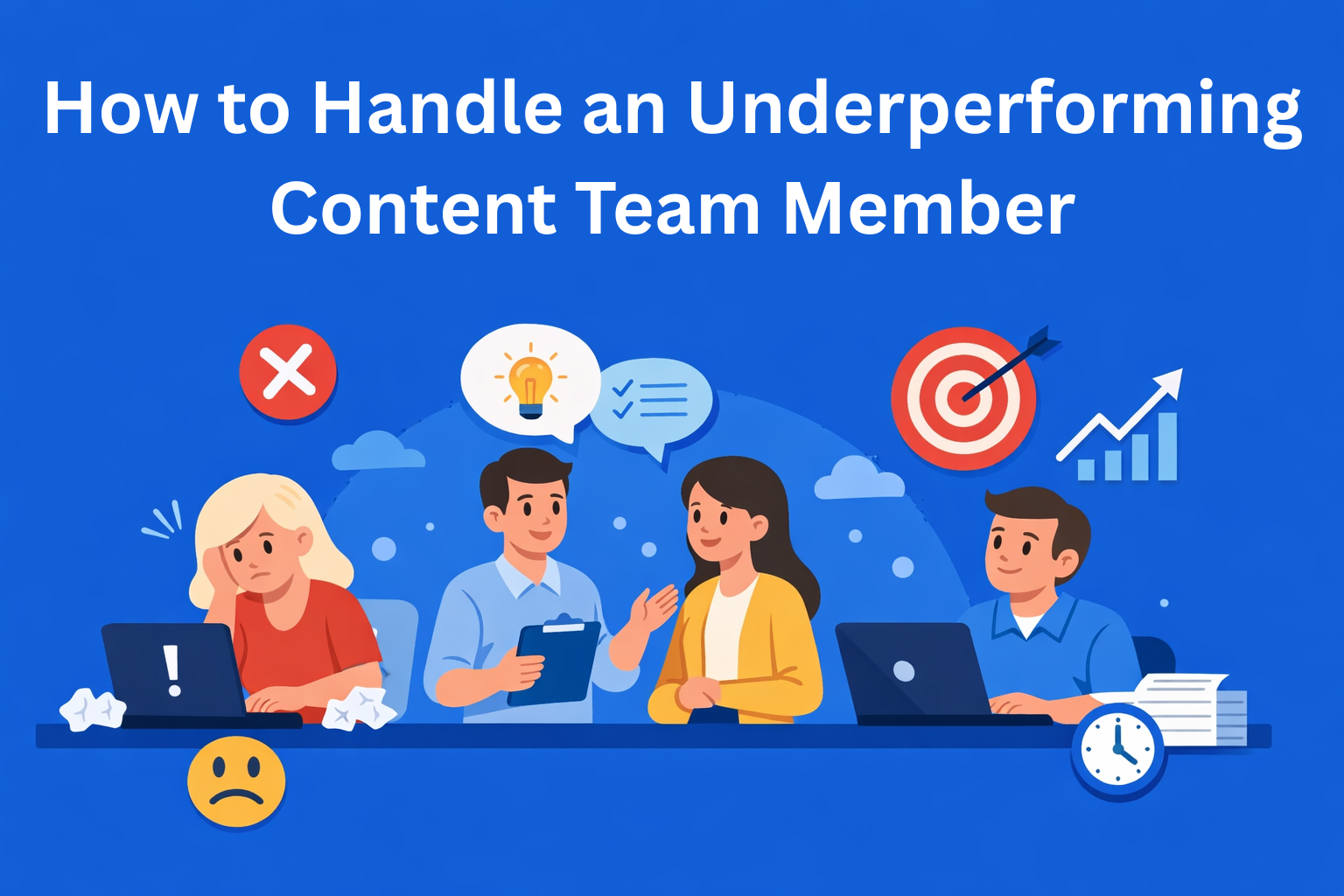
Managing a content team member who is not meeting expectations is one of the hardest tasks for any manager. It is uncomfortable, often emotional, and can easily affect the rest of the team. Still, an underperforming content team member is not a problem that should be ignored. The longer it is postponed, the bigger the consequences become, lower content quality, missed deadlines, and a drop in motivation across the entire team.
In this blog, we will talk about how to recognize problems, have the right conversations, and take concrete steps to improve performance, without harming team atmosphere or slowing down your workflow.
Key Takeaways
- Define underperformance with facts - focus on missed deadlines, repeated revisions, and ignored feedback, not personal impressions.
- Check the process before blaming the person - unclear briefs, shifting priorities, or weak workflows often cause poor results.
- Have early, structured conversations -use concrete examples and questions to understand where things are breaking down.
- Set clear expectations and next steps - agree on what “good” looks like, how feedback is applied, and realistic deadlines.
- Support improvement, but set limits - provide coaching and time to improve, then make fair decisions if progress doesn’t happen.
What does it really mean when someone is “underperforming” in a content team?
When we say that someone is not performing well, we often rely on personal impression. However, an underperforming content team member is not the same as “I don’t like how they work.” Underperformance has clear and visible signs.
These can include:
- frequent missed deadlines,
- content that requires too many revisions,
- ignoring feedback, or
- a complete lack of initiative.
In a content team, this becomes visible very quickly because every issue affects the next step in the workflow, from start to finish.
It is important to separate a temporary drop in performance from a constant problem. Everyone has a bad period. But if the same mistakes repeat week after week, that is a clear sign that something is not working.
Before you react - check whether the problem is the person or the process
One of the most common mistakes in content team management is immediately blaming the individual. In reality, the root cause is often a broken or unclear process.
Ask yourself:
- Are the briefs clear?
- Are expectations defined?
- Does the person know what a “good result” actually means?
If the content workflow is unclear, even the best writer or editor will struggle to do their best work.
Poor tools, too many revisions, unclear comments, or constant changes in priorities directly affect performance. That is why, before talking to the team member, you should honestly evaluate the system they are working in. To make sure the issue is not the process itself, there are tools like EasyContent that help you clearly define workflows, assign roles, communicate in real time, customize templates for different types of content, and keep briefs and ideas easily accessible to the entire team.
How to identify the real cause of poor performance
Once you see that the process itself works, the next step is understanding where the problem actually lies. A content team member can struggle for many different reasons.
Sometimes the issue is knowledge or experience. The person may not feel confident about writing, applying SEO rules, or structuring content properly.
In other cases, the problem is motivation , loss of focus, fatigue, or the feeling that their effort is not being noticed.
There can also be communication issues. If someone does not fully understand feedback or feels uncomfortable asking questions, the same mistakes will keep happening. The goal is not to guess, but to listen and truly understand.
How to start a constructive conversation without tension
Conversation is the most important step when someone in a content team is underperforming. If you delay it for too long, the problem only grows. If it is handled poorly, the person may shut down and become defensive.
It is best to start the conversation with facts, not personal opinions.
Instead of saying “you are always late,” say “in the last three projects, deadlines were missed.” This approach reduces tension and the need for the person to defend themselves.
Questions matter more than accusations. Ask how the person sees the situation and where they feel stuck. For example:
- “How do you see the last few projects?”
- “What was the hardest part of this task for you?”
- “Where do you think things are getting stuck, and how can I help?”
In content team management, the quality of the conversation often determines the outcome.
Setting clear expectations and concrete next steps
A conversation without a clear conclusion rarely leads to change. That is why it is important to define exactly what needs to improve.
Agree on specific goals:
- Content quality , what a “good text” actually means for your team (structure, clarity, style, number of revisions).
- Deadlines , when delivery is expected and how much delay is acceptable.
- Applying feedback , whether comments are truly implemented and whether the same mistakes keep repeating.
Avoid vague phrases like “try harder.” Instead, be specific and realistic.
It also helps to write the agreement down, even as a short message or a task in a tool. This does not mean controlling every step, but making sure both sides clearly understand what was agreed on.
How to provide support without lowering standards
Support does not mean lowering expectations. On the contrary, it means helping someone reach them. With an underperforming content team member, coaching often works better than strict control.
Short and frequent feedback is usually more effective than one big review at the end of the month. Acknowledge progress, but be honest when something is not good enough.
If someone lacks knowledge or confidence, additional training or mentoring can make a big difference. This can be a short explanation, an example of good work, or working alongside a more experienced colleague. At the same time, it is important that this support does not constantly fall on the rest of the team, so others do not become overloaded or frustrated.
Tracking progress and setting realistic expectations
Change does not happen overnight. In content team management, it is important to give enough time for improvement, but not unlimited time.
Agree on how long it is realistic to expect visible progress. This might be a few weeks or one full cycle of tasks. What matters is whether things are moving in the right direction, not whether everything is perfect immediately.
If you see improvement, continue providing support. If, despite all efforts, nothing changes, it may be a sign that this problem cannot be solved in the same way.
Tough decisions when improvement does not happen
The hardest part of management is making decisions that are not pleasant. If an underperforming content team member shows no progress even after clear expectations and support, other options need to be considered.
This can mean changing the role, assigning different types of tasks, or, as a last resort, letting the person go. Although this sounds harsh, in the long run it is often better for both the individual and the team.
It is important that the decision is fair, transparent, and aligned with the team’s values.
Conclusion
Managing poor performance is not a sign of weak leadership, but of mature leadership. Content team management means taking care of people, but also protecting results.
When processes are clear, communication is open, and expectations are realistic, underperformance happens less often. And when it does happen, you know how to respond calmly and professionally.
In the end, the goal is not to “fix” a person, but to build a system in which the entire content team can work better, more confidently, and more successfully in the long run.