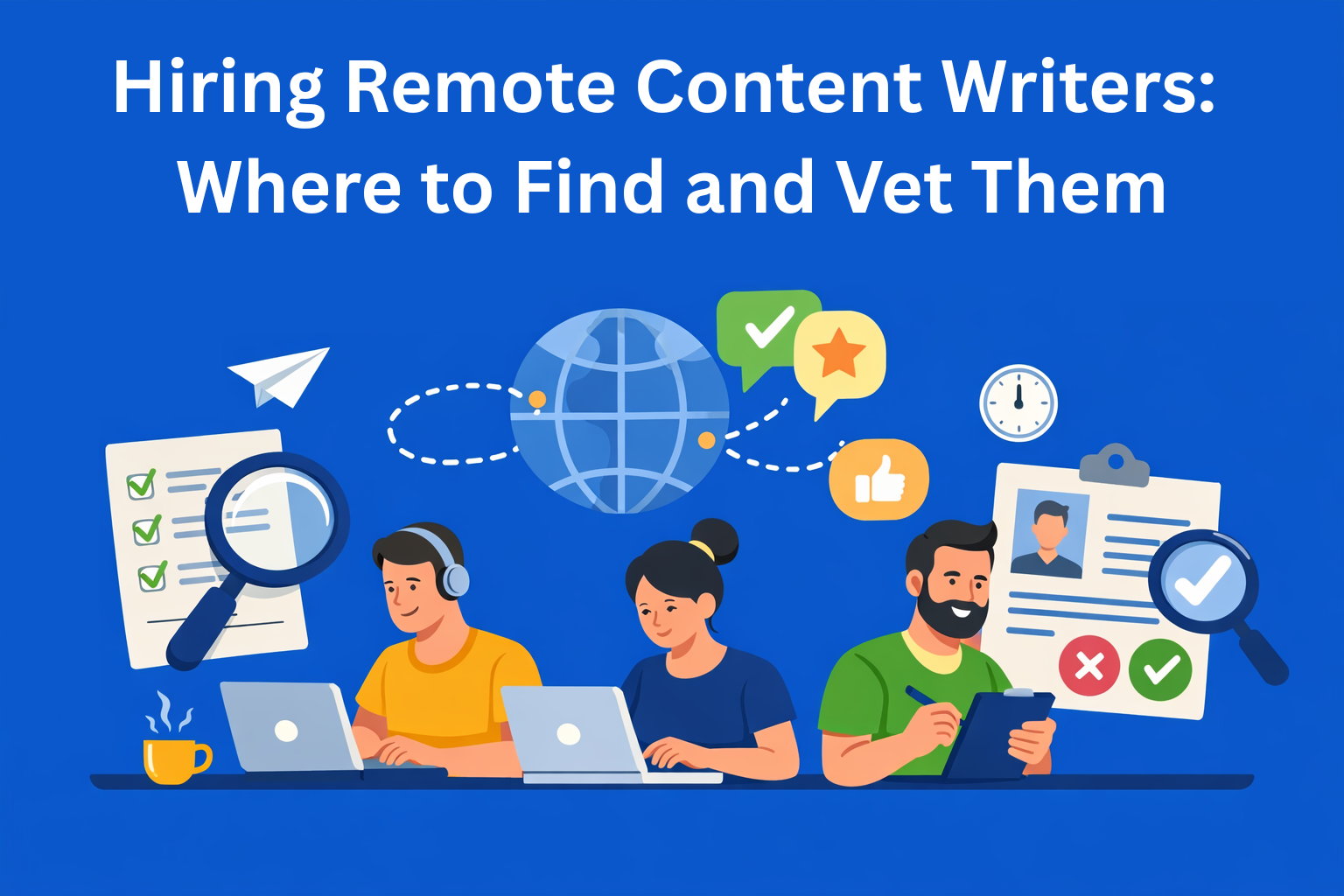
Hiring Remote Content Writers: Where to Find Them and How to Vet Them
Finding good remote content writers isn’t the hard part, choosing the right one is. Learn where to find quality writers and how to vet them properly so you avoid endless edits, missed deadlines, and poor content.

If you’ve ever tried to find a content writer, you probably know how it looks on paper - it seems easy. You post a job, a lot of people apply, you pick someone and think that’s it.
But then reality hits.
The content is not what you expected. The tone is off. You keep editing things. Deadlines get delayed. And at some point, you realize it would’ve been faster if you just wrote everything yourself.
And that’s when most people think there are no good writers.
But that’s not really true.
In most cases, the problem isn’t the people. The problem is where you’re looking and how you decide who to hire.
In this blog, we’ll go through where to find quality remote content writers and, more importantly, how to recognize who is actually good.
Key Takeaways
- Where you search affects writer quality - freelance platforms offer volume, while LinkedIn, communities, and referrals often bring higher-quality and better-matched writers.
- Thinking matters more than writing style - strong writers understand the topic, structure ideas clearly, and solve problems, not just write nice-sounding sentences.
- Test tasks reveal real capability - small practical assignments help you see how a writer thinks, follows instructions, and delivers work in real conditions.
- Communication and reliability are critical - writers who ask questions, meet deadlines, and stay consistent are far more valuable than those who only write well.
- A clear process improves writer performance - structured briefs, defined workflows, and centralized communication help writers deliver better content with fewer revisions.
Where to find quality remote content writers
First, let’s clear one thing up - not all channels are the same.
In some places, you’ll find a lot of people, but the quality is low. In others, there are fewer people, but they’re much better and a better fit for you.
Freelance platforms
Platforms like Upwork or Fiverr are the fastest way to find content writers.
The advantage is clear:
- there are a lot of people
- you can get started quickly
- it’s easy to test multiple writers
But here’s the problem - a lot of people apply, so you have to go through them one by one.
Many send the same generic messages that have nothing to do with your project. A portfolio might look good at first glance, but that doesn’t mean the person will actually do a good job for you.
If you’re using freelance platforms to find remote content writers, focus on what they actually did - real examples and results, not just ratings and stars.
LinkedIn is much better when you’re looking for higher-quality people.
Why?
Because you can see how someone thinks.
You’re not just looking at their writing, but also:
- the posts they publish
- how they communicate
- the topics they talk about
When searching on LinkedIn, don’t overcomplicate it - just type things like content writer, SEO writer, or B2B writer.
Then look at how they write.
If someone can explain things clearly and simply in their posts, there’s a very good chance they’ll be able to do the same for you.
Communities and groups
This is something people often overlook.
There are many Slack, Discord, and Facebook groups where writers hang out. And this is good because there are fewer people, but they’re often higher quality.
Why is that?
Because they’re active, they keep learning, and they stay up to date.
If you’re looking for remote content writers who actually understand what they’re doing, communities are a great place to look.
Referrals
The simplest and often the best solution is to ask:
- colleagues
- other founders
- marketers
If someone has already worked with a writer and had a good experience, you’ve already solved half the problem. When hiring a content writer, referrals are one of the most reliable ways to find someone good.
Your own inbound
If you want something that works long-term, this is the best option.
Just post that you’re looking for writers on your website or LinkedIn.
The people who reach out already know who you are and what you do. That means there’s a much higher chance they’ll be a good fit and match your style.
Why most teams make mistakes
Most people focus on the wrong things.
They look at:
- price
- speed
- a nice-looking portfolio
But that’s not enough.
A good content writer isn’t just someone who writes nicely. A good writer is someone who understands what needs to be said.
There’s a big difference between writing and thinking.
If someone can write nice sentences but doesn’t understand the topic, you’ll have a problem.
That’s why, when hiring remote content writers, how someone thinks matters more than how they write.
How to evaluate a content writer
This is where most people make mistakes.
If you do this part right, you’ll solve 80% of your problems upfront.
Portfolio - but look at it the right way
Don’t just look at whether the text looks nice.
Check:
- Is the text clear?
- Does it make sense from start to finish?
- Does it solve a problem?
If you can read it and understand it easily, that’s a good sign.
If you have to stop and think about what the writer meant, that’s not good.
Test task
This is the most important step.
Give a small, realistic task.
Nothing too complicated, but enough to see:
- how they think
- how they structure content
- whether they follow instructions
The best way to vet remote content writers is to see how they actually work.
Communication
Pay attention to how they communicate.
Do they ask questions?
Do they ask for clarification?
Or do they just say yes and start working?
A good writer wants to understand the task.
A bad writer assumes.
Reliability
This is often more important than writing itself.
- Do they meet deadlines?
- Do they let you know if they’re late?
- Are they consistent?
Someone might write decently, but if they’re always late, that’s a problem. Reliability is key.
Specialization
Not all writers are the same.
Some write about everything. Some focus on specific industries.
If you’re in B2B or SaaS, it’s better to find someone who already understands that space because they’ll adapt faster and produce better content.
How to organize work with writers
Even the best writer will struggle without a good system.
That’s why organization matters.
Clear briefs
Don’t expect someone to guess what you want.
Clearly explain:
- the goal of the content
- who it’s for
- what needs to be said
The clearer you are, the better the result.
Defined process
Who writes? Who reviews? Who approves?
If this isn’t clear, things get messy.
Content goes back and forth and time gets wasted.
One place for communication
If you’re using email, Slack, and Google Docs at the same time - things will get confusing.
Keep everything in one place.
That reduces confusion and speeds things up.
Guidelines and templates
Give writers a structure.
- how the content should look
- what tone to use
- how to structure it
This doesn’t limit creativity.
It just makes the work faster.
If you’re wondering how to implement all of this easily, you can do it through EasyContent - where everything is in one place, which makes content production and communication with writers much simpler.
Common mistakes
Here’s where people usually go wrong:
- choosing the cheapest writer - focusing only on price, and later paying for it with poor quality and endless edits.
- skipping the test task - not checking how someone actually works, and realizing too late it’s not the right fit.
- giving unclear instructions - not explaining what they want, so the writer guesses and the result turns out bad.
- expecting the writer to figure everything out - assuming they’ll “read your mind,” which doesn’t work without clear direction.
- constantly rewriting instead of fixing the process - instead of improving the system, they keep editing content over and over again.
Conclusion
Finding a remote content writer isn’t hard. Finding a good one - that’s a different story. The key isn’t just where you look. It’s how you choose and how you organize the work.
When you have a good process, everything becomes easier.
Good writers stay longer. Results are better. And you spend less time fixing things.
And that’s when content finally starts working for you, not against you.